"Balkan states" redirects here. It is not to be confused with
Baltic states.
Balkans
 |
| Geography |
|---|
| Location | Southeast Europe |
|---|
| Area | 666,700 km2(257,400 sq mi) |
|---|
| Highest elevation | 2,925 m (9,596 ft) |
|---|
| Highest point | Musala (Bulgaria) |
|---|
| Sovereign states |
|---|
| See below |
| Demographics |
|---|
| Demonym | Balkan |
|---|
| Population | 45–50 million (estimation) |
|---|
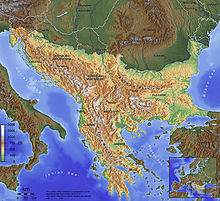
The
Balkan Peninsula, popularly referred to as
the Balkans, is a geographical region of
Southeast Europe.
[1] The region takes its name from the
Balkan Mountains that stretch from the east of
Serbia to the
Black Sea at the east of
Bulgaria. The Balkans are generally considered to include, in whole or in part,
Albania,
Bosnia and Herzegovina,
Bulgaria,
Croatia,
Greece,
Kosovo,
[a] the
Republic of Macedonia,
Montenegro,
Serbia,
Slovenia, and the European part of
Turkey.
[2]
The region is inhabited by
Albanians,
Bulgarians,
Bosniaks,
Croats,
Gorani,
Greeks,
Macedonians,
Montenegrins,
Serbs,
Slovenes,
Romanians,
Aromanians,
Turks, and other ethnic groups which present minorities in certain countries like the
Romani and
Ashkali.
[2]The largest religion on the Balkans is
Orthodox Christianity, followed by
Roman Catholicism and
Islam.
[3]
The total area of the Balkans is 666,700 square km (257,400 square miles) and the population is 59,297,000 (est. 2002).
[2] The Balkans meets the
Adriatic Sea on the northwest,
Ionian Sea on the southwest, the
Mediterranean and
Aegean Sea on the south and southeast, and the
Black Sea on the east and northeast. The highest point of the Balkans is
Mount Musala 2,925 metres (9,596 ft) on the
Rila mountain range in
Bulgaria.
Antiquity and early Middle Ages[edit]
In Antiquity, the Balkan Mountains had been called by the local
Thracian[7] name
Haemus, as well as in the Middle Ages
[8] and thus the Balkan Peninsula was the "Peninsula of
Haemus". The
Thracian king
Haemus, who is likely only a fictitious character, in Greek mythologic fantastics was turned into a mountain by
Zeus as a punishment and the mountain has remained with his name. Apart, there are two equally acceptable theories for the etymology of the name Haemus, one claiming that the name of the mountain was derived apart from mythology, while the other one claiming vice-versa, the one of D. Dechev consider that Haemus (Αἷμος) is derived from a
Thracian word
*saimon, 'mountain ridge'.
[9] The other possibility is that "Haemus" (
Αἵμος) derives from the Greek word "haema" (
αἵμα) meaning 'blood'. The myth goes about the fight of
Zeus and the monster/titan
Typhon. Zeus injured Typhon with a thunder bolt and Typhon's blood fell on the mountains from which they got their name.
[10]
Late Middle Ages and Ottoman period[edit]
The earliest mention of the name appears in an early 14th-century Arab map, in which the
Haemus mountains are referred to as
Balkan.
[11] The popularization of
Balkan began with the arrival of the
Ottomans who first mention it in a document dated from 1565.
[12] There has been no other documented usage of the word to refer to the region before that, despite the fact that other Turkic tribes had already settled earlier or were passing through the Peninsula.
[12] There exists also a claim about an earlier
Bulgar Turkic origin of the word popular in Bulgaria, however it is only an unscholary assertion.
[12] The word was used first by the Ottomans in
Rumelia in its general meaning of mountain, as in
Kod̲j̲a-Balkan,
Čatal-Balkan, and
Ungurus-Balkani̊, but especially it was applied to the Haemus mountain.
[13][14] In Turkish Balkan means "a chain of wooded
mountains" (
balkan),
[15][16]while in
Bulgarian language the word
balkan (балкан) means "mountain".
[17] Another possibility to its etymology is related to
Persian bālk meaning "mud", and the Turkish suffix
an, i.e.
swampy forest.
[18] The name is still preserved in Central Asia with the
Balkan Daglary (Balkan Mountains)
[19] and the
Balkan Province of
Turkmenistan. A less popular hypothesis regarding its etymology is that it derived from the Persian
Balā-Khāna meaning
big, high, house.
Current[edit]
On a larger scale, the mountains are only one part of a long continuous chain crossing the region in the form of a reversed letter S, from the
Carpathians south to the Balkan range proper, before marching away east into
Turkey. The
Balkan Mountains include the
Stara Planina (Old Mountain) mountain range in
Bulgaria and part of
Serbia. On the west coast, an offshoot of the
Dinaric Alps follows the coast south through
Dalmatia and
Albania, crosses Greece, and continues into the sea in the form of
islands.
In the languages of the region, the peninsula is known as:
- Slavic languages:
- Bulgarian: Балкански полуостров, transliterated: Balkanski poluostrov
- Macedonian: Балкански Полуостров, transliterated: Balkanski Poluostrov
- Serbo-Croatian: Балканско полуострво/Balkansko poluostrvo (Serbian and Bosnian), Balkanski poluotok (Croatian), Balkansko Poluostrvo/Балканско полуострво (Montenegrin)
- Slovene: Balkanski polotok
- Romance languages:
- Other languages:
- Albanian: Gadishulli Ballkanik and Siujdhesa e Ballkanit
- Greek: Βαλκανική χερσόνησος, transliterated: Valkaniki hersonisos
- Turkish: Balkan Yarımadası (or alternatively: Balkanlar)
Evolution of meaning[edit]
The first attested time the name "Balkan" was used in the West for the mountain range in
Bulgaria was in a letter sent in 1490 to Pope
Innocent VIII by Buonaccorsi Callimaco, an Italian humanist, writer and diplomat.
[20] English traveler
John Morritt introduced this term into the English literature at the end of the 18th-century, and other authors started applying the name to the wider area between the Adriatic and the Black Sea. The concept of the "Balkans" was created by the German geographer August Zeune in 1808.
[21]During the 1820s, "Balkan became the preferred although not yet exclusive term alongside Haemus among British travelers... Among Russian travelers not so burdened by classical toponymy, Balkan was the preferred term."
[22]
As time passed, the term gradually acquired political connotations far from its initial geographic meaning, arising from political changes from the late 19th-century to the creation of post–
World War I Yugoslavia (initially the
Kingdom of Serbs, Croats and Slovenes). Zeune's goal was to have a geographical parallel term to the
Italic and
Iberian Peninsula, and seemingly nothing more. The gradually acquired political connotations are newer and, to a large extent, due to oscillating political circumstances.
Southeast Europe[edit]
Definitions and boundaries[edit]
The Balkan Peninsula[edit]

The Balkan Peninsula, as defined by the Danube-Sava-Kupa line

Politic map Balkan Peninsula 1827.
Countries whose territories lie entirely within the Balkan peninsula:
Countries that lie partially within the Balkan peninsula:
As of 1920 until
World War II Italy included
Istria and some
Dalmatian areas (like
Zara, known as
Zadar) that are within the general definition of the Balkan peninsula. The current territory of Italy includes only the small area around
Trieste and
Gorizia inside the Balkan Peninsula. However, the regions of Trieste and Istria are not usually considered part of the Balkans by Italian geographers, due to a definition of the Balkans that limits its western border to the Kupa River.
[50]
The Balkans[edit]
The abstracted term "The Balkans" covers those countries which lie within the boundaries of the Balkan Peninsula.
[25] Before 1991, the whole of
Yugoslavia was considered to be part of the Balkans.
[51] The term "The Balkans" is sometimes used to describe only the areas in the Balkan peninsula:
Moesia,
Macedonia,
Thrace,
Kosovo,
Šumadija,
Bosnia,
Herzegovina,
Thessaly,
Epirus,
Peloponnese and others, but often it includes Croatia, Serbia and Romania,
[25] namely the provinces of
Vojvodina,
Banat,
Wallachia,
Moldavia,
Transylvania, and others. Italy as a totality is generally accepted as part of Western Europe and the
Apennines. The term "the Balkans" was coined by August Zeune in 1808.
Broadly interpreted, the term Balkans comprise the following territories:
[52]
 Albania (28,748 km2)
 Bosnia and Herzegovina (51,197 km2)
 Bulgaria (110,993 km2)
 Croatia (56,594 km2)
 Greece (131,990 km2)
 Kosovo (10,908 km2)
 Macedonia (25,713 km2)
 Montenegro (13,812 km2)
 Romania (238,391 km2)
 Slovenia (20,273 km2)
 Serbia (77,474 km2)
 Turkey (23,764 km2)
Western Balkans[edit]
Some institutions
[weasel words][citation needed] and member states of the
European Union have defined the "Western Balkans" as the south-east European area that includes countries that are not members of the European Union, while others refer to the geographical aspects. The Western Balkans is a neologism coined to describe the countries of "ex-Yugoslavia (minus Slovenia) and Albania".
[53] Countries of the western Balkans are Croatia (now an EU member), Serbia, Bosnia and Herzegovina, Montenegro, Kosovo, Macedonia and Albania — or Albania plus the former Yugoslavia, minus Slovenia.
[54][55][56][57][58][59][60][61] Each of these countries aims to join the EU and reach democracy and transmission scores but, until then, they will be strongly connected with the pre-EU waiting program
CEFTA.
[62]
Nature and natural resources[edit]

View toward
Rila, the highest mountain in the Balkans which reaches 2925 m
Most of the area is covered by mountain ranges running from north-west to south-east. The main ranges are the
Balkan mountains, running from the Black Sea Coast in Bulgaria to its border with Serbia, the
Rhodope mountains in southern Bulgaria and northern Greece, the
Dinaric Alps in Bosnia and Herzegovina, Croatia and Montenegro, the
Šar massif which spreads from Albania to Macedonia, and the
Pindus range, spanning from southern Albania into central Greece and the
Albanian Alps. The highest mountain of the region is
Rila in Bulgaria, with
Musala at 2925 m,
Mount Olympus in Greece, the throne of Zeus, being second at 2917 m and
Vihren in Bulgaria being the third at 2914 m. The karst field or
polje is a common feature of the landscape.
On the
Adriatic and
Aegean coasts the climate is
Mediterranean, on the
Black Sea coast the climate is
humid subtropical and
oceanic, and inland it is
humid continental. In the northern part of the peninsula and on the mountains, winters are frosty and snowy, while summers are hot and dry. In the southern part winters are milder. The humid continental climate is predominant in Bosnia and Herzegovina, northern Croatia, Bulgaria, Kosovo, Macedonia, northern Montenegro, the interior of Albania, Romania and Serbia, while the other, less common climates, the humid subtropical and oceanic climates, are seen on the Black Sea coast of Bulgaria and Turkey; and the Mediterranean climate is seen on the coast of Albania, coast of Croatia, Greece, southern Montenegro and the Aegean coast of Turkey.
During the centuries many woods have been cut down and replaced with bush. In the southern part and on the coast there is evergreen vegetation. Inland there are woods typical of Central Europe (
oak and
beech, and in the mountains,
spruce,
fir and
pine). The
tree line in the mountains lies at the height of 1800–2300 m. The landscape provides
habitats for numerous endemic species, including extraordinarily abundant insects and reptiles that serve as food for a variety of
birds of prey and rare
vultures.
The soils are generally poor, except on the plains where areas with natural grass, fertile soils and warm summers provide an opportunity for tillage. Elsewhere, land cultivation is mostly unsuccessful because of the mountains, hot summers and poor soils, although certain cultures such as
olives and grapes flourish.
Resources of energy are scarce, except in the territory of Kosovo, where considerable coal, lead, zinc, chromium, silver deposits are located.
[63] Other deposits of
coal, especially in Romania, Bulgaria, Serbia and Bosnia also exist.
Lignite deposits are widespread in Greece. Petroleum is most notably present in Romania, although scarce reserves exist in Greece, Serbia and Albania. Natural gas deposits are scarce.
Hydropower is in wide use, with over 1,000 dams. The often relentless
bora wind is also being harnessed for power generation.
Metal ores are more usual than other raw materials. Iron ore is rare but in some countries there is a considerable amount of copper,
zinc,
tin,
chromite,
manganese,
magnesite and
bauxite. Some metals are exported.
The time zones are situated as follows:
- Territories in the time zone of UTC+01:00: Albania, Bosnia and Herzegovina, Kosovo, Macedonia, Montenegro and Serbia
- Territories in the time zone of UTC+02:00: Bulgaria, Greece, Romania and Turkey
History and geopolitical significance[edit]
Antiquity[edit]
The Balkan region was the first area of Europe to experience the arrival of farming cultures in the
Neolithic era. The practices of growing grain and raising livestock arrived in the Balkans from the
Fertile Crescent by way of
Anatolia and spread west and north into
Pannonia and Central Europe. Two early culture-complexes have developed in the region,
Starčevo culture and
Vinča culture. Vinča culture developed a form of
proto-writing before the
Sumerians and
Minoans, known as the
Old European script, while the bulk of the symbols had been created in the period between 4500 and 4000 BC, with the ones on the Tărtăria clay tablets even dating back to around 5300 BC.
[6]
The identity of the Balkans is dominated by its geographical position; historically the area was known as a crossroads of cultures. It has been a juncture between the
Latin and
Greek bodies of the
Roman Empire,
[citation needed] the destination of a massive influx of pagan
Bulgars and
Slavs, an area where
Orthodox and
Catholic Christianity met,
[64] as well as the meeting point between
Islam and Christianity.
In pre-classical and
classical antiquity, this region was home to
Greeks,
Illyrians,
Paeonians,
Thracians,
Dacians, and other ancient groups. The
Achaemenid Persian Empire incorporated parts of the Balkans comprising
Macedonia,
Thrace,
Bulgaria, and the
Black Seacoastal region of
Romania between the late 6th and the first half of the 5th-century BC into its territories.
[65] Later the
Roman Empireconquered most of the region and spread Roman culture and the
Latin language, but significant parts still remained under
classical Greekinfluence. The
Romans considered the
Rhodope Mountains to be the northern limit of the Peninsula of Haemus and the same limit applied approximately to the border between Greek and Latin use in the region (later called the
Jireček Line).
[66] The
Bulgars and
Slavs arrived in the 6th-century and began assimilating and displacing already-assimilated (through Romanization and Hellenization) older inhabitants of the northern and central Balkans, forming the
Bulgarian Empire.
[67] During the
Middle Ages, the Balkans became the stage for a series of wars between the
Byzantine Roman and the
Bulgarian Empires.
Early modern period[edit]

Modern political history of the Balkans from 1800 onwards.
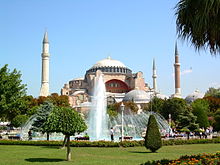
Hagia Sophia, an Eastern Orthodox cathedral built in the 6th-century in
Constantinople (present-day Istanbul, Turkey), later an imperial mosque, and now a museum.
In the past several centuries, because of the frequent
Ottoman wars in Europe fought in and around the Balkans and the comparative Ottoman isolation from the mainstream of economic advance (reflecting the shift of Europe's commercial and political centre of gravity towards the
Atlantic), the Balkans has been the least developed part of Europe. According to Suraiya Faroqhi and Donald Quataert, "The population of the Balkans, according to one estimate,
fell from a high of 8 million in the late 16th-century to only 3 million by the mid-eighteenth. This estimate is in harmony with the first findings based on Ottoman documentary evidence."
[69]
Most of the Balkan nation-states emerged during the 19th and early 20th centuries as they gained independence from the Ottoman Empire or the Austro-Hungarian empire (Greece in 1821, Serbia, Montenegro and Romania in 1878, Bulgaria in 1908, Albania in 1912).
Recent history[edit]
World wars[edit]
In 1912–1913 the
First Balkan War broke out when the nation-states of
Bulgaria,
Serbia,
Greece and
Montenegro united in an
allianceagainst the
Ottoman Empire. As a result of the war, almost all remaining European territories of the
Ottoman Empire were captured and partitioned among the allies. Ensuing events also led to the creation of an independent
Albanian state. Bulgaria insisted on its status quo territorial integrity, divided and shared by the Great Powers next to the
Russo-Turkish War (1877–78) in other boundaries and on the pre-war Bulgarian-Serbian agreement. Provoked by the backstage deals between its former allies Serbia and Greece on allocation the spoils at the end of the First Balkan War, while it fights at the main Thracian Front, Bulgaria marks the beginning of
Second Balkan War when attacked them. The Serbs and the Greeks repulse single attacks, but when the Greek army invaded Bulgaria together with an unprovoked Romanian intervention in the back, regardless of the single won battles, Bulgaria collapsed. The Ottoman Empire also used the opportunity to recapture
Eastern Thrace, establishing its new western borders that still stand today.
The
First World War was sparked in the Balkans in 1914 when members of
Mlada Bosna, a revolutionary organization with predominately Serbian and pro-Yugoslav members,
assassinated the Austro-Hungarian heir
Archduke Franz Ferdinand of Austria in Bosnia and Herzegovina's capital,
Sarajevo. That caused a war between the two countries which—through the existing
chains of alliances—led to the First World War. The Ottoman Empire soon joined the
Central Powers becoming one of the three empires participating in that alliance. The next year Bulgaria joined the
Central Powers attacking Serbia, which was successfully fighting Austro-Hungary to the north for a year. That led to Serbia's defeat and the intervention of the
Entente in the Balkans which sent an expeditionary force to establish a new
front, the third one of that war, which soon also became static. The participation of Greece in the war three years later, in 1918, on the part of the Entente finally altered the balance between the opponents leading to the collapse of the common German-Bulgarian front there, which caused the exit of Bulgaria from the war, and in turn the collapse of the Austro-Hungarian Empire, ending the First World War.
[70]
With the start of the
Second World War all Balkan countries, with the exception of Greece, were allies of
Nazi Germany, having bilateral military agreements or being part of the
Axis Pact.
Fascist Italy expanded the war in the Balkans by using its protectorate Albania to
invade Greece. After repelling the attack, the Greeks counterattacked, invading Italy-held Albania and causing Nazi Germany's intervention in the Balkans to help its ally.
[71] Days before the German invasion a successful coup d'état in Belgrade by neutral military personnel seized power.
[72]
Although the new government reaffirmed Serbia's intentions to fulfill its obligations as member of the Axis,
[73] Germany, using its other two allied countries in the region, Bulgaria and Hungary, invaded both Greece and Yugoslavia. Yugoslavia immediately disintegrated when those loyal to the Serbian King and the Croatian units mutinied.
[74] Greece resisted, but, after two months of fighting, collapsed and was occupied. The two countries were partitioned between the three Axis allies, Bulgaria, Germany and Italy, and the
Independent State of Croatia, a puppet state of Italy and Germany.
During the occupation the population suffered considerable hardship due to repression and starvation, to which the population reacted by creating a mass resistance movement.
[75] Together with the early and extremely heavy winter of that year (which caused hundreds of thousands deaths among the poorly fed population), the German invasion had disastrous effects in the timetable of the
planned invasion in Russia causing a significant delay,
[76] which had major consequences during the course of the war.
[77]
Finally, at the end of 1944, the Soviets entered Romania and Bulgaria forcing the Germans out of the Balkans. They left behind a region largely ruined as a result of wartime exploitation.
Cold War[edit]
During the
Cold War, most of the countries on the Balkans were governed by communist governments. Greece became the first battleground of the emerging Cold War. The
Truman Doctrine was the US response to the
civil war, which raged from 1944 to 1949. This civil war, unleashed by the
Communist Party of Greece, backed by communist volunteers from neighboring countries (Albania, Bulgaria and Yugoslavia), led to massive American assistance for the non-communist Greek government. With this backing, Greece managed to defeat the partisans and, ultimately, remained the only non-communist country in the region.
However, despite being under communist governments,
Yugoslavia (1948) and Albania (1961) fell out with the Soviet Union. Yugoslavia, led by Marshal
Josip Broz Tito (1892–1980), first propped up then rejected the idea of merging with
Bulgaria and instead sought closer relations with the West, later even spearheaded, together with India and Egypt the
Non-Aligned Movement. Albania on the other hand gravitated toward
Communist China, later adopting an
isolationist position.
As the only non-communist countries,
Greece and
Turkey were (and still are) part of
NATO composing the southeastern wing of the alliance.
Post–Cold War[edit]
In the 1990s, the transition of the regions' ex-Soviet bloc countries towards democratic free-market societies went peacefully with the exception of Yugoslavia.
Wars between the former Yugoslav republics broke out after Slovenia and Croatia held free elections and their people voted for independence on their respective countries' referenda. Serbia in turn declared the dissolution of the union as unconstitutional and the
Yugoslavian army unsuccessfully tried to maintain status quo. Slovenia and Croatia declared independence on 25 June 1991, followed by the
Ten-Day War in Slovenia. Till October 1991, the Army withdrew from Slovenia, and in Croatia, the
Croatian War of Independence would continue
until 1995. In the ensuing 10 years armed confrontation, gradually all the other Republics declared independence, with
Bosnia being the most affected by the fighting. The long lasting wars resulted in a United Nations intervention and
NATO ground and air forces
took action against Serb forces in Bosnia and Herzegovina and
Serbia.
From the dissolution of Yugoslavia six republics achieved international recognition as sovereign republics, but these are traditionally included in Balkans:
Croatia,
Bosnia and Herzegovina,
Macedonia,
Montenegro and
Serbia. In 2008, while under UN administration, Kosovo
declared independence (according to the official Serbian policy, Kosovo is still an internal autonomous region). In July 2010, the
International Court of Justice, ruled that the declaration of independence was legal.
[78] Most UN member states recognise Kosovo. After the end of the wars a
revolution broke in Serbia and
Slobodan Milošević, the Serbian communist leader (elected president between 1989 and 2000), was overthrown and handed for trial to the
International Criminal Tribunal for crimes against the
International Humanitarian Law during the Yugoslav wars. Milošević died of a heart attack in 2006 before a verdict could have been released. Ιn 2001 an
Albanian uprising in
Macedonia forced the country to give local autonomy to the
ethnic Albanians in the areas where they predominate.
With the dissolution of
Yugoslavia an issue emerged over the name under which the former (federated) republic of Macedonia would internationally be recognized, between the new country and Greece. Being the
Macedonian part of Yugoslavia (see
Vardar Macedonia), the federated Republic under the Yugoslav identity had the name
Republic of Macedonia on which it declared its sovereignty in 1991. Greece, having a large region (see
Macedonia) also under the same name opposed to the usage of this name as an indication of a nationality. The
issue is currently under negotiations after a UN initiation.
Balkan countries control the direct
land routes between Western Europe and South West Asia (
Asia Minor and the Middle East). Since 2000, all Balkan countries are friendly towards the EU and the USA.
[citation needed]
All other countries have expressed a desire to join the EU at some point in the future.
Politics and economy[edit]

View from
Santorini in Greece.
Tourism is an important part of the Greek economy.
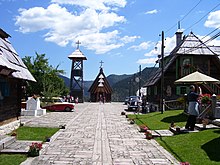
Drvengrad (also known as Mećavnik or Küstendorf), an ethno village in
Serbia and home to the annual
Kusturica film festival
Currently all of the states are republics, but until World War II all except Turkey were monarchies. Most of the republics are
parliamentary, excluding Romania and Bosnia which are
semi-presidential. All the states have
open market economies, most of which are in the upper-middle income range ($4,000 – $12,000 p.c.), however,
Greece has
high income economies (over $12,000 p.c.), and is also classified with very high
HDI in contrast to the remaining states which are classified with high HDI. The states from the former
Eastern Bloc that formerly had
planned economy system and Turkey mark gradual economic growth each year, only the economy of Greece drops for 2012 and meanwhile it was expected to grow in 2013. The Gross domestic product (
Purchasing power parity) per capita is highest in Greece (over $25), followed by Turkey, Bulgaria, Romania, Montenegro, Serbia, Macedonia ($10 – $15), Bosnia, Albania and Kosovo (below $10).
[80] The
Gini coefficient, which indicates the level of difference by monetary welfare of the layers, is on the second level at the highest monetary equality in Albania, Bulgaria and Serbia, on the third level in Greece, Montenegro and Romania, on the fourth level in Macedonia, on the fifth level in Turkey, and the most unequal by Gini coefficient is Bosnia at the eighth level which is the penultimate level and one of the highest in the world. The unemployment is lowest in Romania (below 10%), followed by Bulgaria, Turkey, Albania (10 – 15%), Greece (15 – 20%), Montenegro, Serbia, Bosnia (20 – 30%), Macedonia (over 30%) and Kosovo (over 40%).
- On political, social and economic criteria the divisions are as follows:
- On border control and trade criteria the divisions are as follows:
- On currency criteria the divisions are as follows:
- Territories members of the Eurozone: Greece
- Territories using the Euro without authorization by the EU: Kosovo and Montenegro
- Territories using the national currencies and candidates for the Eurozone: Bulgaria (lev), Romania (leu)
- Territories using the national currencies: Albania (lek), Bosnia and Herzegovina (convertible mark), Macedonia (denar) and Serbia (dinar).
- On military criteria the divisions are as follows:
- On the recent political, social and economic criteria there are two groups of countries:
- Territories with communist past: Albania, Bosnia and Herzegovina, Bulgaria, Kosovo, Macedonia, Montenegro, Romania and Serbia
- Territories with capitalist past: Greece and Turkey
Regional organizations[edit]
Demographics[edit]
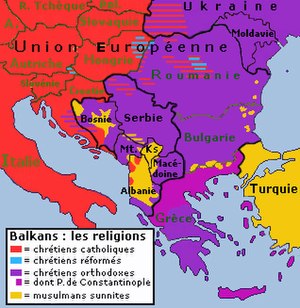
Map showing religious denominations

Distribution of races in the Balkan Peninsula and Asia Minor in 1922, Racial Map of Europe by Hammond & Co.

Distribution of races in the southern Balkan Peninsula in 1918.

Ethnic composition of the northern part of the region in 1880 by the English-German cartograge E.G. Ravenstein

Distribution of races in the southern Balkan Peninsula and Asia Minor in 1918 (National Geographic)
|
| Albania | 2,831,741[81] | 77.4 years |
| Bosnia and Herzegovina | 3,839,737[82] | 74.9 years |
| Bulgaria | 7,814,570[83] | 74.5 years |
| Greece | 11,123,034[84][needs update] | 82 years |
| Kosovo | 1,733,872[85] | – |
| Macedonia | 2,057,284[86] | 74.2 years |
| Montenegro | 625,266[87] | – |
| Romania | 832,141[88] | 72.5 years |
| Serbia | 7,209,764[89] | 74.2 years |
| Turkey | 10,620,739[90] | 75 years[91] |
| Balkans ** | est. 48 million | |
The islands are not taken into account. Both census figures of Serbia and Kosovo in the table do not include North Kosovo, therefore in the population of the Balkans, made up of sum of the populations in the table, is added separately an additional number of 70,000 to include the missing population of North Kosovo.
Religion[edit]
The region's principal religions are Christianity (
Eastern Orthodox,
Catholic) and
Islam (
Sunni).
[3] Eastern Orthodoxy is the majority religion in both the Balkan peninsula and the Balkan region. A variety of different traditions of each faith are practiced, with each of the Eastern Orthodox countries having its own national church.
- Territories in which the principal religion is Eastern Orthodoxy (with national churches in parentheses):
- Territories in which the principal religion is Catholicism:
- Territories in which the principal religion is Sunni Islam:
- Territories in which religious minorities encompass over 10% of the population:
- Territories in which religious minorities encompass less than 10% of the population:
The
Jewish communities of the Balkans were some of the oldest in Europe and date back to ancient times. These communities were
Sephardi Jews, except in
Romania where the Jewish communities were
Ashkenazi Jews. In
Bosnia and Herzegovina, the small and close-knit Jewish community is 90%
Sephardic, and
Ladino is still spoken among the elderly. The Sephardi Jewish cemetery in
Sarajevo has tombstones of a unique shape and inscribed in ancient Ladino.
[92] Sephardi Jews used to have a large presence in the city of
Thessaloniki, and by 1900, some 80,000, or more than half of the population, were Jews.
[93] The Jewish communities in the Balkans suffered immensely during
World War II, and the vast majority were killed during the
Holocaust. An exception were the
Bulgarian Jews, most of whom were saved by
Boris III of Bulgaria, who resisted
Adolf Hitler, opposing their deportation to
Nazi concentration camps. Almost all of the few survivors have emigrated to the (then) newly founded state of
Israel and elsewhere. No Balkan country today has a significant Jewish minority.
Languages[edit]
The Balkan region today is a very diverse ethno-linguistic region, being home to multiple
Slavic,
Romance, and
Turkic languages, as well as
Greek,
Albanian, and others.
Romani is spoken by a large portion of the
Romanis living throughout the Balkan countries. Throughout history many other ethnic groups with their own languages lived in the area, among them
Thracians,
Illyrians,
Romans,
Celts and various
Germanic tribes. All of the aforementioned languages from the present and from the past belong to the wider
Indo-European language family, with the exception of the Turkic languages (e.g.,
Turkishand
Gagauz).
- Territories where the predominant language is from the Albanian language family:
- Territories where the predominant language is from the Hellenic language family:
- Territories where the predominant language is from the Latin language family:
- Territories where the predominant language is from the Slavic language family:
- Bosnia and Herzegovina, Bulgaria, Croatia, Macedonia, Montenegro and Serbia.
- Territories where the predominant language is from the Turkic language family:
- Territories in which there are minority language families encompassing over 10% of the population:
- Macedonia: Albanian language family
Urbanization[edit]
Most of the states in the Balkans are predominantly urbanized; the countries in which the rural population is the majority are Bosnia and Herzegovina and Kosovo each being about 50% rural and 50% urban.
[94]

View of
Sofia from the parliamentary square

Central
Tirana with Mount Dajt in the distance
A list of cities with population of over 150,000 inhabitants:
|
| 1 | Belgrade | Serbia | 1,344,844 | 1,659,440 | 2011[95] |
| 2 | Sofia | Bulgaria | 1,204,685 | 1,359,520 | 2011[96] |
| 3 | Thessaloniki | Greece | 788,952 | 1,104,460 | 2011[97] |
| 4 | Zagreb | Croatia | 686,568 | 1,107,115 | 2011[98] |
| 5 | Athens | Greece | 664,046 | 3,737,550 | 2011[97] |
| 6 | Skopje | Macedonia | 506,926 | 668,518 | 2002[99] |
| 7 | Tirana | Albania | 418,495 | 749,365 | 2011[100] |
| 8 | Sarajevo | Bosnia and Herzegovina | 369,534 | 438,443 | 2013 (preliminary)[101] |
| 9 | Plovdiv | Bulgaria | 339,077 | 403,153 | 2011[96] |
| 10 | Varna | Bulgaria | 334,870 | 343,544 | 2011[96] |
| 11 | Ljubljana | Slovenia | 282,994 | N/A | 2013[102] |
| 12 | Novi Sad | Serbia | 277,522 | 341,625 | 2011[95] |
| 13 | Burgas | Bulgaria | 200,271 | 223,902 | 2011[96] |
| 14 | Niš | Serbia | 183,544 | 260,237 | 2011[95] |
| 15 | Pristina | Kosovoa | 198,000 | 205,133 | 2011[103] |
| 16 | Split | Croatia | 167,121 | 178,102 | 2011[citation needed] |
| 17 | Prizren | Kosovoa | 178,000 | 181,756 | 2011[103] |
| 18 | Patras | Greece | 171,484 | 260,308 | 2011[97] |
| 19 | Podgorica | Montenegro | 156,196 | 189,937 | 2011[104] |
| 20 | Banja Luka | Bosnia and Herzegovina | 150,997 | 199,191 | 2013 (preliminary)[105] |
| 21 | Kragujevac | Serbia | 150,835 | 179,417 | 2011[95] |
| Cities located within the Balkan peninsula, whose countries are not regarded as part of the Balkans |
| Istanbul* | Turkey | 12,919,000 | 14,160,467 | 2013[106] |
| Constanța | Romania | 254,693 | N/A | 2011[107] |
| Çorlu | Turkey | 215,293 | N/A | 2010[108][better source needed] |
| Trieste |  Italy Italy | 205,374 | N/A | 2009[109] |
- [*] İstanbul is partly located in the Balkans, and partly in Asia.
Culture[edit]
See also[edit]
Annotations[edit]
References[edit]
- Jump up^ Colin S. Gray, Geoffrey Sloan. Geopolitics, Geography and Strategy. Retrieved10 November 2014.
- ^ Jump up to:a b c "Balkans". Encyclopædia Britannica. Retrieved 2015-05-03.
The Balkans are usually characterized as comprising Albania, Bosnia and Herzegovina, Bulgaria, Croatia, Kosovo, Macedonia, Montenegro, Romania, Serbia, and Slovenia—with all or part of each of those countries located within the peninsula. Portions of Greece and Turkey are also located within the geographic region generally defined as the Balkan Peninsula, and many descriptions of the Balkans include those countries too. Some define the region in cultural and historical terms and others geographically, though there are even different interpretations among historians and geographers.... Pop. (2002 est.) 59,297,000.
- ^ Jump up to:a b Okey, Robin (2007). Taming Balkan Nationalism. Oxford University Press.
- Jump up^ Borza, EN (1992), In the Shadow of Olympus: The Emergence of Macedon, Princeton University Press, p. 58
- Jump up^ Perlès, Catherine (2001), The Early Neolithic in Greece: The First Farming Communities in Europe, Cambridge University Press, p. 1
- ^ Jump up to:a b Haarmann, Harald (2002). Geschichte der Schrift (in German). C.H. Beck. p. 20.ISBN 978-3-406-47998-4.
- Jump up^ "Bulgaria". Hemus – a Thracian name. Indiana University. p. 54.
- Jump up^ Balkan Studies. 1986.
- Jump up^ Decev, D (1986). Balkan Studies. University of Michigan. Retrieved 20 June 2015.
- Jump up^ "Gods and Heroes of the Greeks: The Library of Apollodorus". Google Books. Retrieved 12 September 2014.
- Jump up^ Dobrev, Ivan (1989). Проиcхождение географического названия Балкан - Sixieme Congres international d'etudes du Sud-Est Europeen (in French). Sofia: Ed.de l'Académie bulgare des Sciences.
- ^ Jump up to:a b c Todorova, Maria N. (1997). Imagining the Balkans. New York: Oxford University Press, Inc. p. 27.
- Jump up^ Encyclopaedia of Islam, Second Edition, Editors: P. Bearman, Th. Bianquis, C.E. Bosworth, E. van Donzel and W.P. Heinrichs. Brill Online Reference Works.
- Jump up^ Balkan.
- Jump up^ "Balkan". Encarta World English Dictionary. Microsoft Corporation. Archived from the original on 31 October 2009. Retrieved 31 March 2008.
- Jump up^ "balkan". Büyük Türkçe Sözlük (in Turkish). Türk Dil Kurumu.
Sarp ve ormanlık sıradağ
- Jump up^ Андрейчин Л. и др., Български тълковен речник (допълнен и преработен от Д. Попов). Четвърто преработено и допълнено издание.: Издателство “Наука и изкуство”. С., 1994
- Jump up^ Current Trends in Altaic Linguistics; European Balkan(s), Turkic bal(yk) and the Problem of Their Original Meanings, Marek Stachowski, Jagiellonian University, p. 618.
- Jump up^ "Balkhan Mountains". World Land Features Database. Land.WorldCityDB.com.Archived from the original on 28 February 2008. Retrieved 31 March 2008.
- Jump up^ Todorova, Maria (2009). Imagining the Balkans. Oxford University Press US. p. 22.ISBN 0-19-538786-4.
- Jump up^ Pavic, Silvia (22 November 2000). "Some Thoughts About The Balkans.". About, Inc.Archived from the original on 28 February 2008. Retrieved 31 March 2008.
- Jump up^ Maria Todorova Gutgsell, Imagining the Balkans (Oxford University Press, 2009; ISBN 0199728380), p. 24.
- Jump up^ "Balkanize". merriam-webster.com.
- Jump up^ Bideleux, Robert; Ian Jeffries (2007). A history of Eastern Europe. Taylor & Francis. p. 37. ISBN 978-0-415-36627-4.
- ^ Jump up to:a b c Jelavich, Barbara (1983). History of the Balkans: Eighteenth and nineteenth centuries. Cambridge University Press. p. 1. ISBN 978-0-521-27458-6.
- Jump up^ "britannica.com". Encyclopedia Britannica. Retrieved 12 September 2014.
- Jump up^ Hajdú, Zoltán (2007). Southeast-Europe: State Borders, Cross-border Relations, Spatial Structures. Pécs, Hungary: Hungarian Academy of Sciences. ISBN 978-9-63-905265-9. Retrieved June 8, 2015.
- Jump up^ Lampe, John R. (2014). Balkans Into Southeastern Europe, 1914-2014: A Century of War and Transition. London, United Kingdom: Palgrave Macmillan. ISBN 978-1-13-701907-3. Retrieved June 8, 2015.
- Jump up^ Švob-Ðokic, Nada, ed. (2001). Redefining Cultural Identities: Southeastern Europe(PDF). Zagreb, Croatia: National and University Library in Zagreb. ISBN 953-6096-22-6. Retrieved June 8, 2015.
- Jump up^ Lonnie Johnson, Central Europe: Enemies, Neighbors, Friends, Oxford University Pres
- Jump up^ "In the Heavy Shadow of the Ukraine/Russia Crisis, page 10" (PDF). European Bank for Reconstruction and Development. September 2014. Retrieved 15 January 2015.
- Jump up^ "UNHCR in Central Europe". UNCHR.
- Jump up^ "Central European Green Corridors - Fast charging cross-border infrastructure for electric vehicles, connecting Austria, Slovakia, Slovenia, Germany and Croatia" (PDF). Central European Green Corridors. October 2014.
- Jump up^ "Interreg CENTRAL EUROPE Homepage". Interreg CENTRAL EUROPE.
- ^ Jump up to:a b Andrew Geddes,Charles Lees,Andrew Taylor : "The European Union and South East Europe: The Dynamics of Europeanization and multilevel goverance", 2013, Routledge
- ^ Jump up to:a b Klaus Liebscher, Josef Christl, Peter Mooslechner, Doris Ritzberger-Grünwald :"European Economic Integration and South-East Europe: Challenges and Prospects", 2005, Edward Elgar Publishing Limited
- Jump up^ Armstrong, Werwick. Anderson, James (2007). "Borders in Central Europe: From Conflict to Cooperation". Geopolitics of European Union Enlargement: The Fortress Empire. Routledge. p. 165. ISBN 978-1-134-30132-4.
- ^ Jump up to:a b United Nations
- ^ Jump up to:a b Michael Hayes. Road memories: aspects of migrant history (Cambridge Scholars Publishing, 2007)
- ^ Jump up to:a b Negri, A.P. (2003). Enlargement of the European Union: The First Or the Last Stage of Integration? : XIII Economic Forum, Krynica, September 4-6, 2003. Fundacja Instytut Studiów Wschodnich. ISBN 9788391795972. Retrieved 2014-12-07.
- Jump up^ United States. Foreign Broadcast Information Service Daily report: East Europe
- Jump up^ CIA The World Factbook – Romania
- Jump up^ Energy Statistics for the U.S. Government
- Jump up^ United States. Foreign Broadcast Information Service Daily report: East Europe
- ^ Jump up to:a b CIA The World Factbook – Turkey
- Jump up^ Steven Tötösy de Zepetnek, Louise Olga Vasvári. Comparative Hungarian Cultural Studies. Purdue University Press. Retrieved 24 November 2014.
- Jump up^ CIA The World Factbook – Serbia
- Jump up^ Armstrong, Werwick. Anderson, James (2007). "Borders in Central Europe: From Conflict to Cooperation". Geopolitics of European Union Enlargement: The Fortress Empire. Routledge. p. 165. ISBN 978-1-134-30132-4.
- Jump up^ "Map of Europe". TheFreeDictionary.com. Retrieved 15 January 2015.
- Jump up^ Istituto Geografico De Agostini, L'Enciclopedia Geografica – Vol.I – Italia, 2004, Ed. De Agostini p.78
- Jump up^ Tintero, Felipa L.; Felicitas R. Manacsa. World Geography Affected by World Upheavals. Goodwill Trading Co., Inc. p. 51. ISBN 971-574-041-3.
- Jump up^ Bideleux, Robert; Taylor, Richard (1996). European integration and disintegration: east and west. p. 249.
- Jump up^ Pond, Elizabeth (2006). Endgame in the Balkans: Regime Change, European Style. Washington, D.C.: Brookings Institution. p. 5. ISBN 978-0815771609.
- Jump up^ Zoltan Hajdu, ed. (2007). "The European integration and regional policy of the West Balkans". Southeast-Europe: state borders, cross-border relations, spatial structures. Ivan Illes, Zoltan Raffay. Centre for Regional Studies. p. 141. ISBN 978-963-9052-65-9. Retrieved 18 October 2014.
- Jump up^ "European Economic and Social Committee – Western Balkans". European Economic and Social Committee. Retrieved 12 September 2014.
- Jump up^ "European Union External Action – EU relations with the Western Balkans". Retrieved12 September 2014.
- Jump up^ Redaktion: PT-DLR. "Federal Ministry of Education and Research of Germany – Western Balkan Countries". Retrieved 12 September 2014.
- Jump up^ Austrian Foreign Miniistry – The Western Balkans – A Priority of Austrian Foreign Policy
- Jump up^ "WBIF – Western Balkans Investment Framework – Stakeholders". Retrieved12 September 2014.
- Jump up^ "European Commission – Trade – Countries and regions – Western Balkans". Retrieved 12 September 2014.
- Jump up^ "Western Balkans: Enhancing the European Perspective" (PDF). Communication from the Commission to the European Parliament and the Council. 5 March 2008. Archived(PDF) from the original on 9 April 2008. Retrieved 8 April 2008.
- Jump up^ "Perspectives on the Region" (PDF). Retrieved 19 July 2013.
- Jump up^ "Regions and territories: Kosovo". BBC News. 20 November 2009. Archived from the original on 15 April 2010. Retrieved 17 April 2010.
- Jump up^ Goldstein, I. (1999). Croatia: A History. McGill-Queen's University Press.
- Jump up^ Joseph Roisman,Ian Worthington A Companion to Ancient Macedonia pp 342-345 John Wiley & Sons, 7 jul. 2011 ISBN 144435163X
- Jump up^ Boundary between Greek and Latin
- Jump up^ Twenty Years of Balkan Tangle. Mary Edith Durham (2007). p.125. ISBN 1-4346-3426-4
- ^ Jump up to:a b Considered a Bulgarian in Bulgaria
- Jump up^ An economic and social history of the Ottoman Empire. Suraiya Faroqhi, Donald Quataert (1997). Cambridge University Press. p.652. ISBN 0-521-57455-2
- Jump up^ Encyclopedia of World War I, Spencer Tucker, Priscilla Mary Roberts, p.242
- Jump up^ Europe in Flames, J. Klam, 2002, p.41
- Jump up^ Russia's life-saver, Albert Loren Weeks, 2004, p.98
- Jump up^ Germany and the 2nd World War Volume III:The Mediterranean, south-east Europe, and north Africa, 1939–1941, Gerhard Schreiber, Bernd Stegemann, Detlef Vogel, 1995, p.484
- Jump up^ Germany and the 2nd World War Volume III:The Mediterranean, south-east Europe, and north Africa, 1939–1941, Gerhard Schreiber, Bernd Stegemann, Detlef Vogel, 1995, p.521
- Jump up^ Inside Hitler's Greece:The Experience of Occupation, Mark Mazower, 1993
- Jump up^ Hermann Goring: Hitler's Second-In-Command, Fred Ramen, 2002, p.61
- Jump up^ The encyclopedia of codenames of World War II#Marita, Christopher Chant, 1986, p.125-6
- Jump up^ "Kosovo independence declaration deemed legal". Reuters. 22 July 2010. Retrieved16 February 2014.
- Jump up^ Ceremony marks the accession of Albania to NATO, NATO – News, 7 April 2009. Retrieved 18 April 2009.
- Jump up^ "Report for Selected Countries and Subjects". International Monetary Fund. 2009–2016.
- Jump up^ "Institute of Statistics of Albania. 2011 Census Results".
- Jump up^ Agency for Statistics of Bosnia and Herzegovina. Estimate for 2011.
- Jump up^ "National Statistical Institute of Bulgaria. 2011 Census Results".
- Jump up^ http://epp.eurostat.ec.europa.eu/tgm/table.do?tab=table&init=1&language=en&pcode=tps00001&plugin=1 Official estimate
- Jump up^ "Statistical Office of Kosovo. 2011 Census Results".
- Jump up^ "State Statistical Office of Macedonia. Estimate for 2010" (PDF) (in Macedonian). Retrieved 17 April 2010.
- Jump up^ "Statistical Office of Montenegro. 2011 Census Results".
- Jump up^ "National Institute of Statistics of Romania. 2011 Census Results." (PDF) (in Romanian).
- Jump up^ "Statistical Office of Serbia. 2011 Census Results".
- Jump up^ "Turkish Statistical Institute".
- Jump up^ "OECD Better Life Index".
- Jump up^ European Jewish Congress – Bosnia-Herzegovina, Accessed 15 July 2008.
- Jump up^ "Greece". Jewish Virtual Library.
- Jump up^ "Data: Urban population (% of total)". The World Bank. 2006–2010.
- ^ Jump up to:a b c d "2011 Census of Population, Households and Dwellings in the Republic of Serbia: Comparative Overview of the Number of Population in 1948, 1953, 1961, 1971, 1981, 1991, 2002 and 2011, Data by settlements" (PDF). Statistical Office of Republic Of Serbia, Belgrade. 2014. ISBN 978-86-6161-109-4. Retrieved 2014-06-27.
- ^ Jump up to:a b c d "ПРЕБРОЯВАНЕ 2011" (PDF) (in Bulgarian). National Statistical Institute of Bulgaria. 2011.
- ^ Jump up to:a b c "Πίνακας 1: Προσωρινά αποτελέσματα του Μόνιμου Πληθυσμού της Ελλάδος: Ανακοίνωση προσωρινών αποτελεσμάτων Απογραφής Πληθυσμού 2011" (PDF) (in Greek). National Statistical Service of Greece. 2011.
- Jump up^ "Popisane osobe, kućanstva i stambene jednice, prvi rezultati popisa 2011 (Grad Zagreb)" (in Croatian). Croatian Bureau of Statistics. 2011.
- Jump up^ Government of the Republic of Macedonia. "2002 census results" (PDF). stat.gov.mk. Retrieved 2010-01-30.
- Jump up^ "Population and Housing Census in Albania" (PDF). Institute of Statistics of Albania. 2011.
- Jump up^ "Census 2013 preliminary" (PDF). Statistical office of Republika Srpska. 2013.
- Jump up^ "Statistical Yearbook Ljubljana 2013". Place Names. City Administration, Department for Development and Investments. Retrieved 18 August 2014.
- ^ Jump up to:a b http://www.ask.rks-gov.net/ballina.
- Jump up^ "Montenegrin 2011 census". Monstat. 2011.
- Jump up^ "2013 census (preliminary)" (PDF). Statistical office of Republika Srpska. 2013.
- Jump up^ "The Results of Address Based Population Registration System, 2013". Turkish Statistical Institute. 31 December 2013. Retrieved 29 January 2014.
- Jump up^ "COMISIA JUDEŢEANǍ PENTRU RECENSĂMÂNTUL POPULAŢIEI ŞI AL LOCUINŢELOR, JUDEŢUL CONSTANTA" (PDF) (in Romanian). National Institute of Statistics of Romania. 2011.
- Jump up^ "Turkey: Registered Population". List of the registered population by cities and provinces in the years 2010 and 2007, quoted from the State Institute of Statistics of the Republic of Turkey. City Population DE. 2010.
- Jump up^ "ISTAT". National Institute of Statistics of Italy. 2009.
Sources[edit]
- Gray, Colin S. (1999). Geopolitics, Geography and Strategy. London, United Kingdom: Routledge. ISBN 978-0-7146-8053-8.
- Banac, Ivo (October 1992). "Historiography of the Countries of Eastern Europe: Yugoslavia". American Historical Review (University of Chicago Press) 97 (4): 1084–1104.doi:10.2307/2165494. JSTOR 2165494.
- Banac, Ivo (1984). The National Question in Yugoslavia: Origins, History, Politics. Ithaca, N.Y.: Cornell University Press. ISBN 978-0-8014-9493-2.
- Goldstein, Ivo (1999). Croatia: A History. Montreal, Quebec, Canada: McGill-Queen's University Press. ISBN 978-0-7735-2017-2.
- Carter, Francis W., ed. An Historical Geography of the Balkans Academic Press, 1977.
- Dvornik, Francis. The Slavs in European History and Civilization Rutgers University Press, 1962.
- Fine, John V. A., Jr. The Early Medieval Balkans: A Critical Survey from the Sixth to the Late Twelfth Century [1983]; The Late Medieval Balkans: A Critical Survey from the Late Twelfth Century to the Ottoman Conquest. Ann Arbor: University of Michigan Press, [1987].
- Jelavich, Barbara (29 July 1983). History of the Balkans. Cambridge University Press.
- Jelavich, Charles and Jelavich, Barbara, eds. (1963). The Balkans in Transition: Essays on the Development of Balkan Life and Politics Since the Eighteenth Century.University of California Press.
- Kitsikis, Dimitri (2008). La montée du national-bolchevisme dans les Balkans. Le retour à la Serbie de 1830. Paris: Avatar.
- Lampe, John R., and Marvin R. Jackson; Balkan Economic History, 1550–1950: From Imperial Borderlands to Developing Nations Indiana University Press, 1982
- Király, Béla K., ed. East Central European Society in the Era of Revolutions, 1775–1856. 1984
- Komlos, John (15 October 1990). Economic Development in the Habsburg Monarchy and in the Successor States. East European Monographs No. 28. East European Monographs. ISBN 978-0-88033-177-7.
- Mazower, Mark (2000). The Balkans: A Short History. Modern Library Chronicles. New York: Random House. ISBN 0-679-64087-8.
- Stavrianos, L. S. (1 May 2000) [1958]. The Balkans since 1453. with Traian Stoianovich. New York: NYU Press. ISBN 978-0-8147-9766-2.
- Stoianovich, Traian (September 1994). Balkan Worlds: The First and Last Europe. Sources and Studies in World History. New York: M.E. Sharpe. ISBN 978-1-56324-032-4.
External links[edit]
 | Wikimedia Commons has media related to Balkans. |
 | Wikivoyage has a travel guide for Balkans. |
 | Look up balkans in Wiktionary, the free dictionary. |
 | Wikiquote has quotations related to: Balkans |


_1803.jpg)


